

San Sebastián is the most beautiful city in Spain. It is not an opinion: it is the verdict of practically everyone who visits it for the first time. La Concha Bay, with its perfect half-moon shape and the island of Santa Clara in the center, is one of the most photographed urban landscapes in Europe. The Old Part concentrates more pintxos bars per square metre than any other city in the world. And the restaurants of San Sebastián - with more Michelin stars per inhabitant than Tokyo - are the reason why many travelers from all over the world make the trip expressly.

San Sebastián (Donostia in Basque) is a city of 186,000 inhabitants on the Cantabria coast of the Basque Country, 20 km from the French border. Its scale is perfect: small enough to walk it, large enough to have a cultural, gastronomic and leisure offer that exceeds five times larger cities. This guide gives you everything you need to make the most of it, from a day to a week.
La Concha Bay: the landscape that explains everything
The first impact of San Sebastián is always the same: the bay. Whether you arrive by train, by car or by bus, the first moment you see La Concha Bay complete from one of the city's sights is a moment that puts your hairs on top. A closed bay almost perfectly circular, two kilometres in diameter, with the fine sand beach curving from the tip of Mount Igueldo to the beginning of Mount Urgull, and the island of Santa Clara in the center as if someone had deliberately put it there to complete the composition.
The Playa de La Concha and its continuation, the Ondareta beach, are the most beautiful urban beaches in Spain and are in the world top of city beaches. The water of the Cantabric is cold (between 16 and 22 ° C according to the time) but clean, and the promenade that borders the bay - the Paseo de La Concha with its modernist iron railing - it is one of the most elegant and popular coastal walks in Europe.
To understand the bay from the sea, the best time is at dawn or at sunset, when the light completely changes the color of the water. And to see it from above, the two mountains that flank the bay offer opposite and complementary perspectives.
Monte Urgull: the history of the city from above
The Mount Urgull is the mountain that protects the port and the Old Part from the east. At 124 meters high, it has on top the statue of the Sacred Heart (visible from all the bay) and the remains of the Castle of the Mota, a medieval fortress that controlled the port of San Sebastián for centuries.
The ascent is made on foot through a network of roads through the forest that covers the mountain (25-30 minutes from the Old Part). From the top there are two completely different views: to the north, the open Atlantic with the island of Santa Clara in the foreground; to the south, the whole city with La Concha and Mount Igueldo in the background. The access is free and the road is comfortable for any level of physical form.
In the skirt of Mount Urgull, next to the fishing port, is the Aquarium de San Sebastián: an aquarium of centuries-old tradition (opened in 1928) with a collection of marine fauna of the Cantabric especially interesting for families.
Mount Igueldo: the most iconic viewpoint
The Mount Igueldo Close the bay to the west and have the most photographed view of San Sebastián: the complete view of La Concha from 181 meters high, with the entire bay in the perfect frame. To get up there is a historical funicular opened in 1912, with original wooden wagons that rise on the hillside in 3 minutes. At the top there is a family attractions park of the 20th century, the Mount Igueldo Attractions Park, with classic attractions that have an absolutely particular retro charm.
Mount Igueldo is about 3 km from the centre, accessible by bus (line 16 from the centre) or on a pleasant walk along the promenade of La Concha and Ondareta.
The Old Part: the epicenter of the world's painters

The Old Part (Alde Zaharra in Basque) is the historic town of San Sebastián, a rectangle of just six blocks between Mount Urgull and the Urumea River that concentrates the highest density of pintxos bars in the world. In the streets of Fermín Calbetón, August 31, San Jerónimo and Mayor, the bars have been competing for decades to have the best painters in the city, and the level they have reached is directly extraordinary.
The ritual is simple: you go into any bar, you point out what you want from the bar (there are cold, hot, exposed painters that are done at the moment) or you ask directly, you take a txakoli or a beer, converts with whom you have next (the San Sebastián painters bars are the most sociable places in Spain) and you follow the next. A round in three or four bars in the Old Part is one of the most complete and economical gastronomic experiences you can have in Spain.
If it's your first time and you don't want to get lost between the offer or you want to know exactly what to ask for and what to avoid, a gastronomic tour guided by a local is the best investment:
San Sebastián gastronomic tour: Pintxos, drinks and tapas with a local - Top rated. 3h 30min tour of the best pintxos bars in the Old Part with a local guide expert in Basque cuisine. Perfect rating of 5.0 with more than 97 reviews. It's constantly running out. From €75.
The most iconic paintings in San Sebastián that you can't help but try:
Gilda: the oldest and most iconic painting of the Old Part. An olive, a glove and an anchovy of the Cantabric crossed by a stick. Simple, salty, perfect.
Txangurro on toast: sea ox with onion, tomato and brandy on toast. The most elegant sea painting.
Foie gras with Txakoli reduction: the modern and high-kitchen version that has conquered the Old Part in recent years.
Codorniz egg fungi: The mushrooms of Mount Aizkorri with ointment egg are one of the most tasty painters of autumn donostiarra.
The gastronomy of San Sebastián: the city with the most Michelin stars in the world
San Sebastian has more restaurants with Michelin star per inhabitant than any other city in the world, including Tokyo, Paris or New York. This statement, which seems exaggerated, is strictly true and has a fascinating historical explanation.
It all started in the '70s with the New Basque Kitchen, a movement led by a group of chefs from the Basque Country (Juan Mari Arzak, Pedro Subijana, Karlos Arguñano, among others) that applied the techniques of the French nouvelle cuisine to the local Basque product: the anchovy of the Cantabric, the fungi of the mountains, the cod, the peppers of Gernika, the peas of Mendavia, the txakoli. The result was a new kitchen that preserved the essence of the local product but transformed it with cutting-edge techniques.
Today the heirs of that revolution - Arzak (3 Michelin stars), Mugaritz (2), Kokotxa (1), Ulia Mirador (1) - are world-wide references of high cuisine. But the extraordinary thing about San Sebastián is that this culture of gastronomic excellence has permeated even the most humble bars in the Old Part: even in the simplest bar, the pinx has a quality level that in other cities you would only find in restaurants of high price.
La Rioja from San Sebastián: wineries and wines in one day
San Sebastián is only 120 km from La Rioja, the most famous wine-growing name in Spain. The mountain road that crosses the Basque Country inside and down to the Ebro Valley is one of the most beautiful landscape routes in the north of the Peninsula.
Private excursions to La Rioja from San Sebastián are some of the most valued experiences of the FeelRoute catalogue for the city, especially among travelers with interest in wine:
Private Day in Rioja from San Sebastián - Top rated. 9 hours full day visiting La Rioja wineries with private guide. Perfect 5.0 rating with more than 80 reviews. From €506.
Premium small group tour of La Rioja without cork from San Sebastián - 8h 30min of small group excursion with visit to iconic wineries. 4.8 of valuation, from €307.
Rioja Uncorked: Private Wine Experience from San Sebastián - Top rated. The most exclusive option: 9 hours of private experience in La Rioja premium wineries. 5.0 of valuation, from €517.
La Rioja Private Tour 3 wineries from San Sebastián - 10 hours visiting three different wineries to compare styles and vineyards. From €752.
- Council: The excursions to La Rioja from San Sebastián are especially recommended in September and October, during the harvest. The vineyards at their most colourful moment, the activity in the lagoons and the atmosphere of celebration of the harvest add a completely different dimension to the visit.
The French Basque Country from San Sebastián
20 km from San Sebastián is the French border, and on the other side the French Basque Country (Iparralde in Basque): Biarritz, Saint-Jean-de-Luz, Bayona. A completely different industrial architecture from the Spanish, belle époque villas, an Atlantic coast with waves perfect for surfing and a gastronomy that mixes the best of Basque and French cuisine.
Full-day private French Basque field from San Sebastián - Top rated. 7 hours with private guide exploring the interior and coast of the French Basque Country. 5.0 of valuation, from €350.
This same tour can also be done by arriving from Bilbao: see the tour of Biarritz, Saint-Jean-de-Luz and San Sebastián from Bilbao If you get to the area by Bilbao.
San Sebastián by bike
San Sebastián is a city perfectly adapted for the bike: it has more than 30 km of bike lane that connect the Old part with the residential neighborhoods, the promenade of La Concha with Mount Igueldo and the center with the beach of Zurriola. The Paseo de La Concha by bike at dawn, when there are no pedestrians yet, is a difficult experience to overcome.
Private bike tour by San Sebastián - Top rated. 2h 30min private tour through the most beautiful points of the city by bike with guide. Perfect rating of 5.0 with more than 21 reviews. From €145.
Itinerario San Sebastián: how to organize the visit
If you have 1 day in San Sebastián
Tomorrow: walk through La Concha from Mount Urgull to Ondareta. Get up to Monte Urgull for the views. Midday: Pintxos in the Old Part (minimum 3-4 bars, a pair of pintxos each). Afternoon: funicular to Mount Igueldo for the views of the bay. Night: Second round of painters in the Old Part or dinner at one of the restaurants on San Jerónimo Street.
If you have 2 days in San Sebastián
Day 1: The Concha, Old Party, Monte Urgull and the gastronomic tour of pintxos. Day 2: Zurriola Beach (the surf beach, east of the Urumea River), the Gros district (more alternative and less tourist than the Old Part), visit the Kursaal (the conference center designed by Rafael Moneo, one of the most recognizable contemporary buildings in northern Spain) and free afternoon to explore the shops in the center.
If you have 3 days or more
With more time you can add: an excursion to La Rioja (the most special day if you like wine), a day in the French Basque Country (Biarritz and Saint-Jean-de-Luz), a visit to Hondarribia (the most beautiful medieval town of Gipuzkoa, 20 km away) or an afternoon in the Museum of San Telmo (the most important Basque museum, in a convent of the 16th century).
San Sebastián as an excursion from Bilbao
If you stay in Bilbao and want to do San Sebastián as a one-day tour, it is perfectly viable: there are 100 km between the two cities (1 h by car, 1 h 20min by train). The organized tour is the most comfortable option because it includes stops at several points between Bilbao and San Sebastián:
From Bilbao: Excursion to San Sebastián, Hondarribia, Hendaya and Getaria - 10 hours with transport from Bilbao, visiting San Sebastián plus the most beautiful villages on the gipuzcoana coast. 4.7 with more than 437 opinions. From €45.
Read also our complete guide to what to see in Bilbao if you combine both cities on the same trip.
Basque gastronomy: what you have to eat in San Sebastián
Pintxos: the essential
We have already mentioned them, but it is worth repeating: the route of paintings by the Old Part is the most representative experience of San Sebastián. The best bars by area:
Calle Fermin Calbetón: the most concentrated street of quality pintxos bars. La Cepa, Bar Txepetxa (specialized in anchovy), Bar Borda Berri.
August 31st Street: More quiet than Fermin Calbetón, with historic bars and neighborhood atmosphere.
Constitution Square: The most beautiful square in the Old Part, with the numbers of the old windows of the bullring on the facades. The bars on the square have a perfect terrace for the vermu.
Anchoas del Cantábrico
The anchovies of the Cantabric - especially those of Getaria and Ondarroa - are the most valued marine product in the Basque Country. Cured in salt for months and then preserved in olive oil, they have a texture and a taste that has nothing to do with industrial anchovy. In San Sebastián they are served alone on bread, as pintxo or as part of any menu dish.
Pil pil and vine cod
The two great dishes of the Basque cod. The pil pil is the white and creamy sauce that is formed by emulsifying the cod gelatin with olive oil; the vine is the red pepper choricero sauce that gives a deep and slightly smoked taste. Both dishes are essential in any traditional Basque restaurant.
Txakoli
The slightly sparkling and very acid white wine of the Basque Country, served from a certain height to air the wine and potentiate its bubbles. It is the wine of the pintxos, the wine of the Old Part, the wine of San Sebastián. The name of origin Txakoli de Getaria (Getariako Txakolina) has the most famous vineyards.
What to see in the surroundings of San Sebastián
Hondarribia: the medieval village on the border
Hondarribia is 20 km from San Sebastián, in the estuary of the Bidasoa River that separates Spain from France. The medieval town of the 15th century - with its wooden houses with flower balconies and its steep streets - is the best preserved on the entire Basque coast. The marina and the fishing district (La Marina) have a completely different atmosphere from the high hull: terrace on the sea, fish stalls, pintxos bars with a view to the river.
Getaria: the cradle of the txakoli and the designer Balenciaga
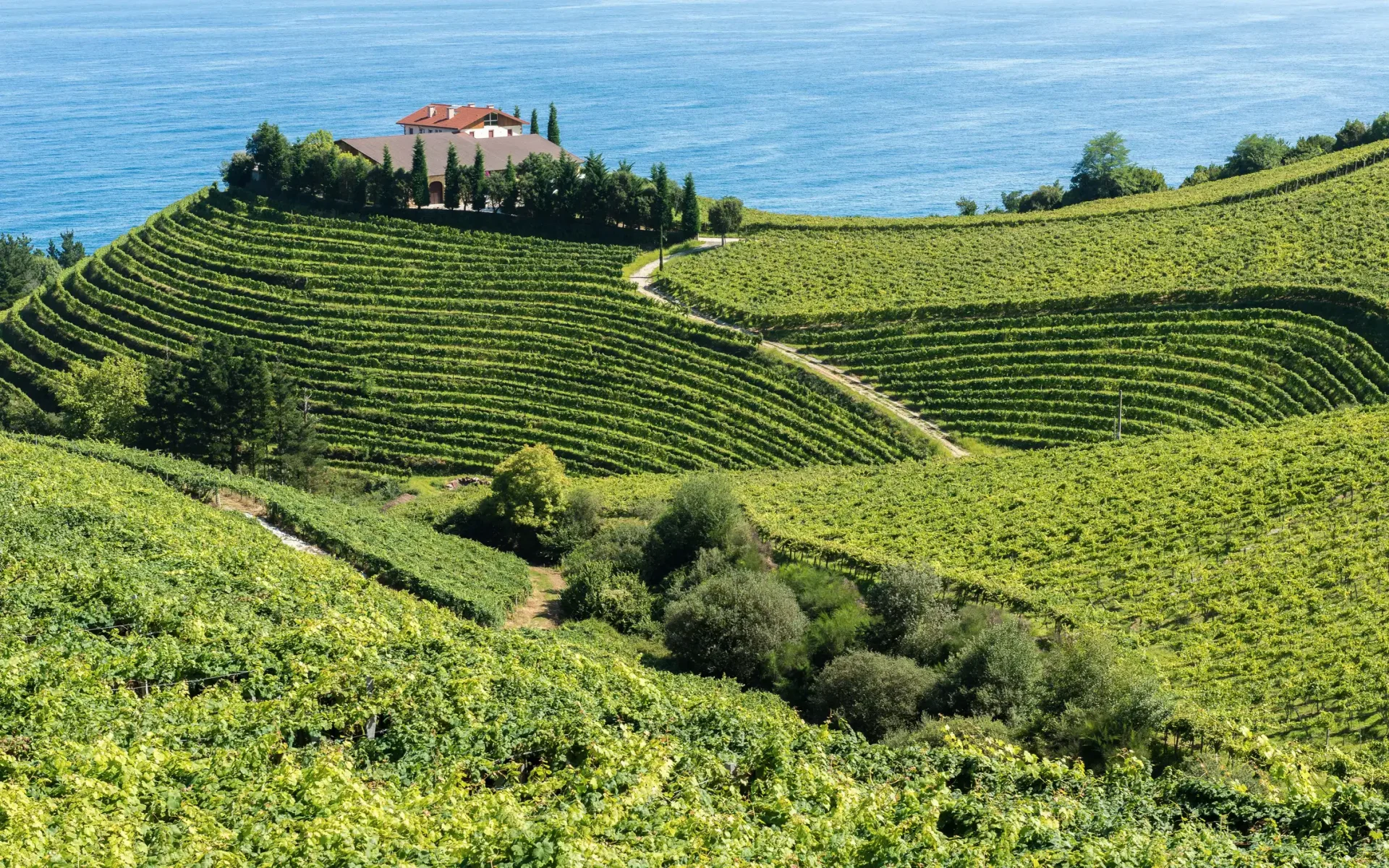
Getaria It is a small fishing village 25 km from San Sebastián with two reasons to visit: it is the cradle of the best txakolis in the world (its vineyards on the slope of the sea are of extraordinary beauty) and it is the hometown of Cristóbal Balenciaga, the most important modist of the 20th century. The Balenciaga Museumopened in 2011 in the designer's home palace, it is one of the most important fashion museums in the world.
The coast of Gipuzkoa: from Zarautz to Zumaia
The stretch of coast between Zarautz and Zumaia has some of the most spectacular geological landscapes in the world: flysch of Zumaia, a series of perfectly vertical sedimentary rock strata that record 60 million years of Earth history, is a UNESCO Geopark and one of the most impressive geological outflows known.
When it's best to visit San Sebastián
San Sebastián has an Atlantic climate: fresh and humid, with frequent rain in autumn and winter and soft summers (rarely above 28 ° C). For the beach, summer is the only real option (July and August), although the water of the Cantabric never reaches the temperatures of the Mediterranean.
For the gastronomic or cultural traveller, September and October are the perfect months: the sea is still temperate, the most important festivals of the year (the San Sebastián International Film Festival in September, the Musical Quincena) are on the move and the presence of tourists is significantly declining over the summer.
The Big Week (Nagusia Sting) In August it is the most important festival in the city: night fireworks on the bay for weeks, concerts, shows and an animation that completely transforms the city. The hotels are filled months in advance.
Practical tips for visiting San Sebastián
How to get there
From Madrid: AVE to Burgos + conventional train, or direct flight to Bilbao airport (60 km from San Sebastián) or to San Sebastián (7 km from the center, with limited flights).
From Barcelona: train with transhipment in Zaragoza or Vitoria, or flight to Bilbao.
From Bilbao: EuskoTren train (1h 40min) or car (100 km, 1h).
From France: TGV train to Hendaya (border) and regional train to San Sebastián (30 min).
How to move
San Sebastián is perfectly walking: the distance from the Old Part to Mount Igueldo is about 3.5 km. Urban buses connect all the neighborhoods to the center. The taxi or Uber for the night trips or to climb Mount Igueldo if you don't want to use the funicular.
Where to stay
Old Part: in the heart of the painters and the night environment. Noise guaranteed in summer and weekends.
Center / Barrio del Buen Pastor: quieter than the Old Part, with good shops and close to La Concha.
Gros district: the youngest and most alternative neighborhood, with the beach of Zurriola and a more local and less tourist painting scene.
Budget
San Sebastián is a face compared to the Spanish average: hotels in the high season are among the most expensive in the country. The bar pintxos (2-4 €the unit) allow you to eat very well without spending much if you know how to handle yourself. The Michelin star restaurants have menus tasting from 150-200 €. A traveller with a medium budget can plan between €120 and €180 per person per day.
Related items that may interest you
What to see in Bilbao: a complete guide to tours and gastronomy - the neighbouring city only 100 km.
Frequently asked questions about what to see in San Sebastián
How many days do I need to visit San Sebastián?
With 2 days you can see the essential: The Concha, the Old Part, the painters and Mount Igueldo. With 3 days you can add the district of Gros, the Museum of San Telmo and an excursion to Hondarribia or Getaria. To make La Rioja or the French Basque Country, you need at least 4-5 days.
Are the painters in San Sebastián expensive?
The bar painters cost between 2 and 4 €the unit, which is perfectly reasonable for the quality you get. A complete round in four or five bars (two pintxos and one drink each) costs you between €20 and €35 per person. Compared to any restaurant of similar quality in Europe, it is extremely economic.
Is San Sebastián better in summer or autumn?
For the beach, summer (July-August) is the only real option. For everything else - painting, gastronomy, museums, excursions - the autumn (September-October) is superior: without the crowds of summer, with the sea still temperate, with the harvest in La Rioja and with the most important festivals of the year.
What's the difference between paint and tapas?
The Basque painters are generally not free (paid per unit), they have a more careful preparation and presentation than the Andalusian medium cover and are smaller but more intense in size. The traditional Andalusian cap came free with the drink; the Basque pintxo is a gastronomic product in itself that has a price of its own.
Can you visit San Sebastián in one day from Bilbao?
Yes, perfectly. There are 100 km between the two cities (1 h by car). The tour organized from Bilbao that includes San Sebastián, Hondarribia and Getaria covers the most important points in 10 hours. If you go by train, the EuskoTren takes 1h 40 min from Bilbao.
How many Michelin stars does San Sebastián have?
The province of Gipuzkoa, with San Sebastián as its capital, has about 20 restaurants with Michelin star. The most famous is Arzak (3 stars by chef Juan Mari Arzak and his daughter Elena), considered one of the best restaurants in the world for decades. Mugaritz (2 stars, chef Andoni Luis Aduriz), in the municipality of Rentería, 10 km from San Sebastián, is another major reference for the world's avant-garde cuisine.
Conclusion: San Sebastián, Mediterranean perfection in the north
San Sebastián has the paradox of being an Atlantic city with a Mediterranean soul: the slow, the street culture, the cult of the table and at the time well used are more from the south than from the north. But the light of the Cantabrian, the tides and the green cliffs surrounding the city are unmistakably Atlantic.
It is a city that works perfectly on any scale: a day of passage gives you La Concha and the painters, which are enough to understand why so many people change something when they visit. A whole week gives you high gastronomy, excursions to La Rioja and the French Basque Country, surfing in Zurriola at dawn and festivals. And in any case, the return is guaranteed.
You ready to plan everything? Discover all the tours and experiences available in San Sebastián in FeelRoute with free cancellation and instant confirmation.


