

Córdoba is the city most unjustly treated by mass tourism in Spain. Millions of travelers visit it every year on one-day excursions from Seville or Granada, take the picture of the forest of columns of the Mosque and leave without understanding what they have seen. This guide exists so that it does not happen to you: that in one day you will take a complete, honest and exciting image of the city that for more than two centuries was the most powerful capital in the Western world.

Because that was Córdoba. In the 10th century, during the Califate of Córdoba, this city on the banks of Guadalquivir had between 500,000 and 1,000,000 inhabitants, when Paris or London had 20,000 or 30,000. It was the largest, richest and most cultured city in the Western world: with a library of 400,000 volumes, public lighting on its streets, free hospitals for the poor and a coexistence between the three monotheistic cultures - Islam, Judaism and Christianity - that the rest of Europe would take centuries to understand. This city is still here, on its stones, on its streets and in the most extraordinary building that can be visited in Spain.
What you need to know before you start
How long do you need to see Córdoba?
Cordoba can be seen in a day if you organize yourself well. You will not see everything - the city has enough layers for a week - but the essential: the Mosque - Cathedral, the historic town, the Jewish Quarter, the Patios and the Roman Bridge. With that well-used day you will take a complete and exciting picture of the city.
If you have two days, the second can be dedicated to the Palacio de Medina Azahara (the Palatina del Califa city, 8 km from the center, one of the most impressive archaeological excavations in Spain) and to the white villages in the area.
How to get to Córdoba
From Seville: AVE in 45 minutes (the fastest and most comfortable connection). There is also a bus in 1h 30min. By car are 145 km by the A-4, about 1h 30min.
From Madrid: AVE in 1h 45min. It is one of the oldest high-speed connections in Spain.
From Granada: by car are 165 km (1h 45min). By train there is transhipment; the direct bus takes about 2h 30min.
From Malaga: by car are 185 km (2h). By train with transhipment or by direct bus (about 2h 30min).
- Council: If you go from Seville or Madrid in AVE, the Cordoba station is a 15-minute walk from the historic center. You can arrive in the morning, make the full day and return in the afternoon without any accommodation. It is the excursion of a more perfectly traced day of Andalusia.
The Mosque: book the entrance before leaving the house
The Mezquita- Cathedral of Córdoba is the most visited monument of Andalusia after the Alhambra of Granada. In high season (Easter, summer, bridges) the queues to enter can exceed 2 hours. Always book the online entry before going. The difference between having the entrance reserved and not having it may be the difference between seeing the Mosque or losing the monument of the journey.
Check all entry options in our complete guide: Tickets for the Cordoba Mosque: how to buy tickets, prices and tips.
Itinerario Córdoba in 1 day: hour per hour
9: 00 - Arrival and first coffee in the Plaza de la Corredera
The Plaza de la Corredera It is the only porticada square in Andalusia, a rectangular Spanish square from the 17th century which seems to be taken from Castilla la Mancha and which is surprising for that precisely in the heart of Córdoba. The bars of the square serve the best breakfast in the center: toast with extra virgin olive oil, coffee alone and the Cordobese salmoire (if offered at this time, try it without hesitation).
The square also has a local product market on Tuesday and Saturday morning that is worth seeing if your visit matches.
9: 30h - The historical centre: the Roman Temple and the Arab quarter
From Corredera Square, walk west through the streets of the historic town. In five minutes you will find the columns of the Roman Temple of Córdoba, built in the 1st century AD and rediscovered under the City Hall in the 1950s. Ten columns of white marble 9 meters high in the city centre: an image that perfectly summarizes the layers of history that this city has.
He continues to walk towards the Mosque through the medieval streets of the historic Arab town. Many of these streets are only 2 or 3 meters wide, white and have names that reveal their past: Calle de los Juíos, Calle de la Luna, Calleja de las Flores. They are the urban fabric of the Califal Cordoba, almost intact after more than 1,000 years.
10: 30 - THE MEZQUITA-CATEDRAL: the most extraordinary monument in Spain

Book at least 2 hours for the Mosque. Do not do it in a hurry: it is the monument that is lost the most quickly seen and the more won is seen slowly.
Start with the Patio of the Orange, the courtyard of ablutions of the old mosque, with oranges in perfect formation and a central source. From here you can access through the Forgiveness Gate inside the monument.
The first impact when entering is the most difficult to describe: forest of 856 columns of granite, jaspe and marble, many of them reused from Roman buildings and visigoths, with arches of double height in red and white alternated that extend in all directions until lost in the penumbra. It is one of the most unique architectural spaces in the world: it does not look like a church, it does not look like a mosque, it seems something earlier and deeper than either one.
The elements you can't miss:
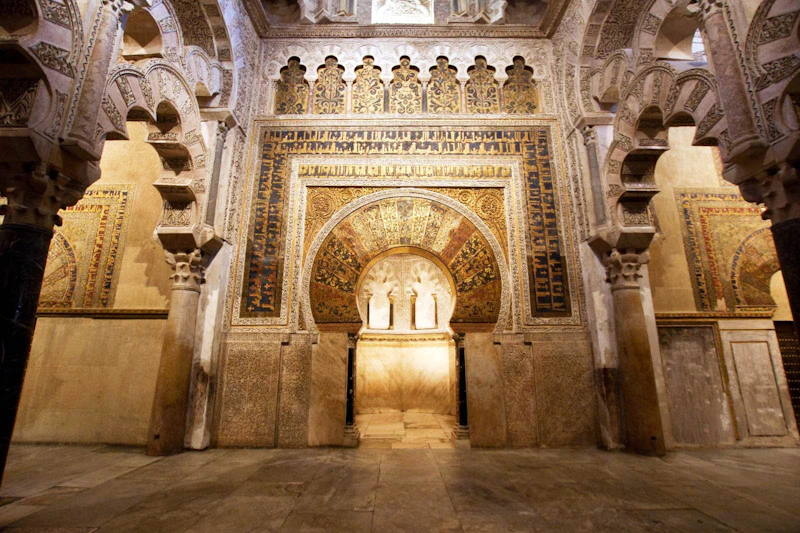
The Mihrab: the hornin oriented towards Mecca that marks the central point of the old mosque. It is decorated with mosaics of gold tesels sent by the Byzantine Emperor, with Arab calligraphy of the 10th century and with a deer-shaped dome that has no equivalent in Islamic architecture.
La Maqsura: the space reserved for the Caliph during prayer, with the most elaborate calated marble celosies in the Islamic world.
The Inner Renaissance Cathedral: built in the 16th century in the exact center of the mosque, it is a high-quality Gothic-Renaissance cathedral that Charles I himself (who authorized its construction) lamented when he saw it finished: "They have destroyed something unique to do something that can be seen anywhere." Today the historical controversy enriches the visit: the two buildings together are more interesting than either one separately.
The Alminar / bell tower: the outer tower built around the original light of the 10th century It can be uploaded with a separate entrance and the views on the roofs of the historic centre and the Guadalquivir are spectacular.
If you want to make the most of the visit, the option with guide is the most recommended. The architecture of the Mosque has so many historical layers that without explanation it is easy to pass over without understanding what you are seeing:
Patios de Córdoba: Guided tour - Guided tour that combines the history of the Cordobese courtyards with the visit to the historical centre. 2 hours with expert guide, accessible for people with reduced mobility. From €19.
13: 00 - The Jewish Quarter: the medieval Jewish Quarter

A few meters from the Mosque, the the Jewish Quarter is one of the best preserved medieval Jewish neighborhoods in Europe. During the Caliphate, Cordoba had one of the largest and most influential Jewish communities in the world: Jewish philosophers, doctors, poets and mathematicians worked in the Califal Court of Abderan III and Al-Hakam II with complete religious freedom and social recognition.
The needs of the neighborhood:
Synagogue of Córdoba: one of the three medieval synagogues that are preserved in Spain (the other two are in Toledo). Built in 1315, it is a building of small dimensions but with an extraordinary mudejar decoration. Close on Monday.
House of Separad: museum dedicated to the history of the Sephardic Jews of Spain. An intimate and well-cured space that explains the expulsion of 1492 and the subsequent diaspora.
Statue of Maimonides: the most important philosopher and doctor of the medieval Jewish tradition, born in Córdoba in 1138. Its statue in the square that bears its name is one of the meeting points of the neighborhood.
Calleja de las Flores: the most photogefic alley in Córdoba, with geranium pots on the gilded facades and the mosque tower at the bottom. It's the postcard image of the city.
14: 30 - Lunch: salmorejo, bull's tail, and Montilla's wine
Cordobese cuisine has its own personality within Andalusian cuisine. Lunch in Córdoba is an experience in itself if you know what to ask:
Cordobese salmorejo: the cordobese version of the gazpacho, thicker and creamy, made of bread, tomato, garlic and olive oil from the Guadalquivir Valley. It is served with grated hard egg and Iberian ham. It is the most identifiable dish of the Cordoba cuisine and in Córdoba it is made better than anywhere else.
bull rabbit: the most emblematic stew of the Cordoba cuisine. Tissue of stew bull for hours with wine, vegetables and spices until the meat is broken. It's a strong dish that needs wine.
Cordobese flamenquin: serrano ham rolled in pork, empanate and fried. A perfect bite as a top or as a main dish in a large version.
Montilla- Moriles wine: the designation of wine origin of the province of Córdoba, the younger sister of the wines of Jerez. The fine of Montilla, dry and with a unique saline minerality, is the wine with which to drink the salmojo and the bull's tail.
The best areas to eat in the center of Córdoba: the area of Calle Romero, the surroundings of Plaza de la Corredera and the taverns of the Jewish Quarter.
16: 30 - The Cordobese Patios: World Heritage Site

The Patios de Córdoba are a unique tradition in the world: private interior courtyards of the houses of the historic center, open to the public throughout the year and especially during the Festival of the Patios of May (declared the Intangible Cultural Heritage of Humanity by UNESCO), when the owners compete to have the most beautiful and floral courtyard in the city.
Outside the May Festival, many courtyards are still accessible throughout the year. The most accessible are in the San Basilio district and in the Jewish area. The tradition of the Cordobese courtyard comes directly from the Arab architecture: a private, interior space with water and vegetation that regulates the temperature of the house and provides a shelter of silence and freshness inside the urban bustle.

The best months to see the courtyards in all their splendor are May and June, when the flowering of geraniums, buganvillas, jazmines and carnations reaches its maximum. But even in winter or summer, the patios have a special atmosphere that deserves to be visited.
18: 00 - The Alcazar of the Christian Kings
The Alcazar of the Christian Kings is the palate-fortress that the Spanish kings built in the 14th century after the Reconquist, on the location of the old Califal palace. It was here that the Catholic Kings received Cristóbal Colón before his first trip to America and where the Court of Inquisition operated for decades.
The Alcázar has four towers, rooms decorated with Roman mosaics of the second century (found during the excavations of the Cordobe subsoil) and a Arab style gardens absolutely spectacular: ponds with springs, centenary cypresses, oranges and jasmine aromas that in spring and summer make the walk through the gardens a memorable sensory experience.
19: 30 - The Roman Bridge and the Calahora at sunset

The gold brooch of the day. The Puente Romano de Córdoba was built in the time of Augusto, in the 1st century BC, on the Guadalquivir. Its original 16 arches (although well restored over the centuries) are the historical access to the city from the south. The view of the Roman Bridge with the Mosque at the bottom and the golden river by the sunset light is the most iconic image of Córdoba and one of the most beautiful of Andalusia.
At the other end of the bridge is the Tower of the Calahorra, an Arab defensive tower of the 14th century turned into a museum that gives a panoramic view of the history of Córdoba from its Roman foundation to the Caliphate. The tower terrace has the best front view of the Roman Bridge and the Mosque throughout the city.
This is the time to sit on one of the veils by the river, order a fine Montilla wine and let yourself be carried by the sunset light on the arches of the bridge. One of those postcards that stays forever.
The Mosque - Cathedral in depth: everything you need to know
Summary history
The Mosque was built on a visigod basilica in 785 by order of the Emir Abderran I. Over the next 200 years it was extended in four different phases by its successors, to reach its current dimensions of 23,400 m ². After the Reconquest in 1236 it was consecrated as a cathedral. In the 16th century the Renaissance cathedral was built in its central interior. The whole set was declared a World Heritage Site by UNESCO in 1984.
Prices and schedules
The times vary according to the season. In summer (September-June) usually open from 10: 00 to 19: 00 from Monday to Saturday and from 8: 30 to 11: 30 and from 15: 00 to 19: 00 on Sundays and holidays (the first hours of Sunday are for worship and the tour is restricted). In winter the closing hours are advanced. Always check the updated schedule before going.
For all entry options and updated prices, see our guide: Mezquita de Córdoba: tickets, prices and tips.
Clothing code
The Mosque-Cathedral is a building in use as a cathedral. Clothes are required to cover the shoulders and knees. You are not allowed to enter with short pants, sleeves-free T-shirts and beach clothes. If you go in summer and wear beach clothes, you'll have to cover yourself with something before you go in.
The Festival of the Patios of Córdoba: if you can, organize your visit in May
If you have the option to choose when to visit Córdoba, choose May. The Festival of the Patios of Córdoba is held the second and third week of May and transforms the city into something that has no equivalent anywhere else in the world.
During the festival, more than 50 private courtyards open their doors to the public for free. The owners have been preparing for flowering for months: thousands of geraniums, carnations, buganvillas and jazmines hang from the walls, surround the fountains and cover the petal floors. The smell of flowers mixed with that of recent lime is one of the most intense and unexpected aromas that Spain can offer.
The atmosphere in the courtyards during the festival is completely different from that of the rest of the year: music, neighbors who receive visitors proudly, children who run among the pots and tourists from all over the world who line up to enter a private courtyard of 40 square meters full of flowers.
Cordoba as a one-day tour: from Seville and from Madrid
Córdoba is perfect as a one-day tour from Seville (45 minutes in AVE) or from Madrid (1h 45min in AVE). If you come from Seville, check all the organized excursions available in our guide to excursions from Seville.
If you stay in Seville and want to organize the excursion independently: nearby train or AVE from the Santa Justa de Sevilla station to the Córdoba station (45min - 1h 30min according to the train). The historic centre of Córdoba is 10-15 minutes walk from the station.
Related items that may interest you
Seville in 3 days: full itinerary and essential experiences - the city from which most travelers make the excursion to Córdoba.
Granada in 3 days: Alhambra, Albaicín and flamenco in cave - the other great Andalusian city essential.
Route of the White Peoples of Andalusia: a complete guide - the natural environment of Córdoba and the countryside.
Madrid in 3 days: full itinerary - if you combine Cordoba with a visit to the capital.
Excursions from Seville: the best one-day tours in Andalusia
Frequently asked questions about Cordoba in 1 day
Is it enough for a day to see Cordoba?
Yes, with a well-organized day you can see the essentials: the Mosque-Cathedral, the Jewish Quarter with the Sinagogue, the Patios, the Alcázar, the Roman Bridge and the medieval historical centre. What you won't see in a day is Medina Azahara (the palatina city of Califa 8 km away), the Archaeological Museum and the most remote neighborhoods of the center. That would take at least two days.
How long does it take to see the Cordoba Mosque?
With tranquility, between 1h 30min and 2 hours. If you go with guided tour, the guide optimizes time and takes you directly to the most important points with context. If you go alone, you may take less but also miss fundamental details.
When is it better to visit Córdoba?
Spring (especially May for the Festival of Patios) and autumn are the ideal times. The summer in Córdoba is extreme: it can reach 45 ° C in July, which makes it very hard to visit the historic center in the middle of the noon sun. If you go in summer, early: at 9: 00 it is still bearable and the Mosque has fewer people.
Is it worth hiring a guide to the Cordoba Mosque?
Yeah, especially if it's your first visit. The Mosque has 1,200 years of history on its stones and without explanation it is very easy to pass over the most important elements without understanding its meaning. A well-prepared guide transforms a good visit into an experience that stays with you forever.
Is the visit to the Cordoba Mosque expensive?
The general entrance to the Mezquita- Cathedral is around €10-13. The rise to the tower is an additional cost. Children under 10 come in for free. Compared to other major European monuments and the impact of the visit, it is a very reasonable entrance.
Is Córdoba prettier than Seville or Granada?
It's an unanswered question, but it does have useful nuances. Córdoba has the most impressive individual monument of Andalusia (the Mosque) and the most authentic and intimate Arab historical centre. Seville has more first-level monuments, more life and more general spectacularity. Granada has the Alhambra. All three are essential in any route through Andalusia.
Conclusion: Córdoba, the city that time respected

There are cities that keep their history in museums. Córdoba keeps it in the streets, in the courtyards, in the arches and in the air. Walking through the historic centre of Córdoba is literally walking on the floor of the Caliphate: the stones of the streets, the traces of the walls, the curves of the streets are the same as the philosophers, doctors and poets of the wisest city in the Western world a thousand years ago.
That's what you take from Córdoba if you visit it well: not only the photo of the forest of columns, but the understanding that there was a time and a place where Islam, Judaism and Christianity built something extraordinary together. And that place is here, perfectly preserved, waiting for you.
Ready to plan it? Discover all the tours and experiences available in Córdoba in FeelRoute, with free cancellation and instant confirmation.


